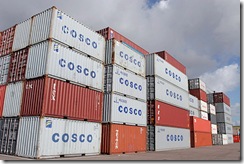
China’s two biggest container carriers, China Cosco and China Shipping Container Line (CSCL), are no strangers to bloody balance sheets. In the first half, China Cosco posted a loss of US$207 million, compared with a $151 million loss a year earlier.
CSCL had a first-half loss of $205 million, compared with a $100 million loss a year earlier. Rising fuel costs and falling freight rates, especially on Asia-Europe routes, are keeping the lines in the red.
Alphaliner reports that vessel utilisation levels on Asia-Europe have been below 90 percent since May this year, with weaker than expected peak season demand causing spot rates on Asia-EU and Asia-Med routes to fall by 40 percent.
As two massive, unwieldy state-owned shipping lines, one can’t help wondering what, if any, pressure there is for the carriers to improve their profitability. Shareholders are certainly not an issue.
But it seems that even Beijing has a limit when it comes to tolerating losses. Three beers into Friday’s happy hour, a buzzing Blackberry brought the news that China Cosco and CSCL planned to join forces in the domestic shipping market to try to weather the market downturn.
The carriers have agreed to jointly operate trade routes from northern and northeastern China to Fujian Province and Shantou in the southern province of Guangdong from mid-October. Both lines, which control 80 percent of the domestic shipping market between them, will supply the ships.
In a statement, Hong Kong-listed CSCL said the move was part of “intensive cooperation in domestic container shipping” between the lines.
What it also did was reignite long-running speculation that China’s two major carriers will merge. Back in May, we heard that the Assets Supervision and Administration Commission (ASAC), a statutory body that controls state-owned enterprises, had put pressure on the lines to combine operations in a bid to offset their huge losses.
At a casual glance it makes heaps of commercial sense. Why have two massive lines, both owned by the state, competing with each other on all routes? Merging CSCL and Cosco would create a carrier with a 1.3 million TEU capacity, close behind the world’s third biggest line, CMA-CGM. If done properly, a large but lean carrier offering economies of scale and serving all the main routes would be able to take on all the top lines.
There is a problem, however, which is that it would take a lengthy and Herculean effort to merge the two lines. Together, the companies operate about 140 shipping, port and even finance companies in a gigantic web of interests that would confuse even the most focused spider.
A top level merger may be some ways off, but joining forces on the domestic China trade could be the start of a consolidating move towards a bright and maybe even loss-free future.
source: maritimeprofessional.com
