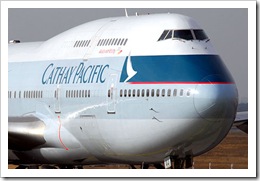
Cathay Pacific has bowed to pressure from environmental groups and banned shark fin from its cargo flights as well as on its subsidiary carrier Dragonair. The move by the airline - believed by environmentalists to fly up to 50 per cent of all shark fin imported by air to Hong Kong - was hailed as a major victory for opponents of the trade, reported the South China Morning Post.
Cathay imposed the ban Dragonair weeks after receiving a letter signed by 40 groups ranging from Greenpeace Hong Kong and the Hong Kong Dolphin Conservation Society to the US-based Humane Society Internationaland Ric O'Barry's Dolphin Project.
The green groups estimate that Cathay Pacific flew up to 650 tonnes of shark fin into Hong Kong last year. The airline has declined to put a figure on how much it carried, but is understood to have told campaigners that it only carries a fraction of that amount.
The airline said: "Cathay Pacific has decided to stop shipping unsustainably sourced sharks and shark-related products. "The carrier expects the transition to this new policy will take approximately three months as it notifies shippers and puts the appropriate procedures in place. However, effective immediately, Cathay Pacific will not enter into any new contracts in this regard." Cathay Pacific said it had been researching the issue for "a very long time".
"Due to the vulnerable nature of sharks, their rapidly declining population, and the impact of overfishing for their parts and products, our carriage of these is inconsistent with our commitment to sustainable development," it said.
The letter from environmentalists was sent in late July and followed by talks between the petitioners and the airline.
The letter said: "Hong Kong government data indicates that over 10,200 [tonnes] of shark fin were imported into Hong Kong in 2011, of which 13 per cent was by air cargo. With an estimated 20 to 50 per cent flown on Cathay Pacific Cargo, up to 650 tonnes of shark fin were potentially imported by Cathay Pacific alone last year."
Hong Kong-based photographer Alex Hofford,co-author of the letter, said: "[The airline's move] sends a strong signal to the trade and to Hong Kong in general. For a big blue-chip company like Cathay Pacific to do the right thing is brilliant."
Hofford said the move would restrict the availability of shark fin in Hong Kong and on the mainland. Hong Kong handles about half the world's shark fin trade. "That was the whole idea behind this - to put a stranglehold on the trade," he said.
Asked how much shark fin Cathay Pacific carries on its cargo planes a year, a spokeswoman said: "It would take some research to determine the exact number. More important, however, is that we used to ship it and now we're going to stop."
The shark fin the airline transported came primarily from Southeast Asia for the Hong Kong and mainland markets, where shark's fin soup is popular at wedding banquets, she said. The airline stopped serving shark's fin soup to first and business class passengers some years ago.
Ali Bullock, the airline's digital marketing manager, said: "I'm really proud of Cathay Pacific for taking a bold and important environmental step to protect sharks."
Activists estimate that fins from up to 73 million sharks are traded worldwide every year. More than half of the shark species are at risk of extinction now or in the near future, they say. Last year, The Peninsula hotel in Hong Kong took shark's fin soup off its menu, followed by the Shangri-La chain. But campaigners said the hoped-for domino effect on other five-star hotels had not materialised.


