Monday, April 10, 2017

Container Crane Terbesar Di Pelabuhan Tanjung Perak Surabaya Telah Beroperasi

Container Crane Terbesar Di Pelabuhan Tanjung Perak Surabaya Telah Beroperasi

Pada Kamis 4 April 2017, Container Crane baru PT Terminal Petikemas Surabaya nomor 14 di dermaga internasional, resmi memberikan layanan bongkar muat penuh untuk kapal CSCL Santiago berbobot 26.404 GT, berbendera Hongkong dengan kapasitas 2.500 TEUs.

President Director Yon Irawan, bersama direksi lainnya mengawasi langsung di dermaga internasional kegiatan bongkar muat dengan CC terbesar di pelabuhan Tanjung Perak tersebut.

“Hari ini CC nomor 14 sudah mulai dioperasikan, yang dua unit masih proses uji coba dan commissioning, dalam beberapa hari lagi satu persatu CC yang memiliki jangkauan hingga 16 row tersebut siap melayani kapal-kapal raksasa yang mampir di Pelabuhan Tanjung Perak," tutur Yon.

Dengan beroperasinya CC baru tersebut, otomatis akan menambah kinerja bongkar muat kapal akan lebih cepat.

Saat ini, dermaga Internasional TPS dilengkapi dengan 10 CC untuk pelayanan petikemas internasional, dua unit CC masih dalam masa ujicoba.

Untuk dermaga domestik, dilengkapi dengan tiga unit CC. Tiga unit Container Crane di TPS memiliki twin lift spreader, sehingga mampu mengangkat petikemas 2 x 20 feet secara bersamaan.

“Semoga kegiatan bongkar muat hari ini bisa berlangsung lancar, dan spreader twinlift dapat bekerja sesuai harapan sehingga dapat mempercepat kegiatan bongkar muat petikemas dari dan ke kapal,” harap dia.

artikel terkait:

"Besar harapan kami dapat menambah jumlah arus kapal-kapal internasional dengan rute langsung atau direct call, karena TPS mampu menangani kapal sekelas panamax dan post panamax," imbuh Yon.(chi/jpnn)

---------------------------------------------------------------

container handling company in indonesia - quantum indonesia

Wednesday, September 9, 2015

APL Logistics Opens New Vietnam Facility

APL Logistics Opens New Vietnam Facility
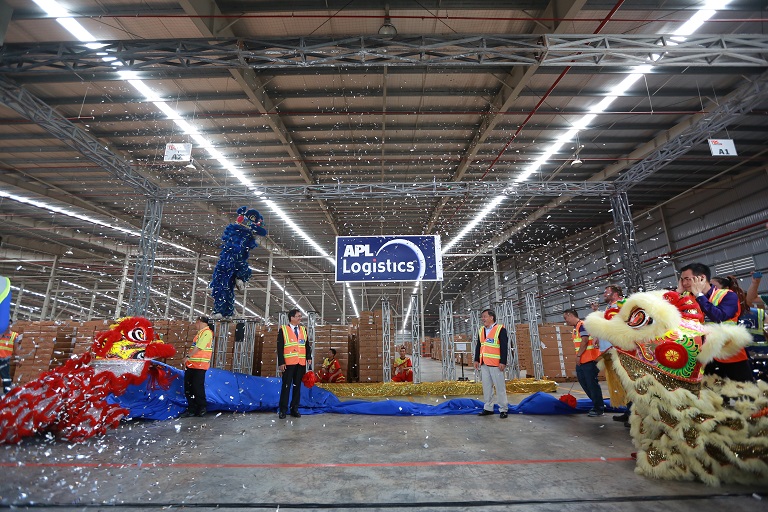
APL Logistics announced the opening of its latest consolidation center in Ho Chi Minh City, Vietnam. It is the largest single-roof container freight station (CFS) within the company’s South East Asia CFS network. The facility will add further scale to the company’s consolidation and value-added services network for customers with growing global and regional sourcing needs.

The CFS is strategically located near major sea and airports around Ho Chi Minh City. It includes over 500,000 square feet of bonded / CFS warehouse space, 80,000 square feet of secured parking space easily accommodating 200 forty-foot trucks, and 170 loading and receiving bays, translating to approximately 170 trucks at one time. Besides being scale-efficient, transport time to international sea and airports will be equal or better than existing facilities around the city. The facility is also compliant with international standards for security and safety with environmentally-friendly features.

Wednesday, May 13, 2015

APL Logistics Opens New Container Freight Station in Jakarta

APL Logistics Opens New Container Freight Station in Jakarta
APL Logistics announced the opening of a new container freight station (CFS) at the Tungya Collins Terminal in Cakung, North Jakarta.

The new CFS extends APL Logistics’ footprint in Indonesia where it offers export consolidation and warehousing services. It also complements APL Logistics’ existing facilities across Asia as a sourcing hub for both international and domestic distribution.

Tuesday, May 12, 2015

Maersk Completing Order of 10 Container Megaships

Maersk Completing Order of 10 Container Megaships
Maersk Line, the world’s biggest container-shipping operator by capacity, is completing an order of 10 container megaships from Korea’s Daewoo Shipbuilding & Marine Engineering Co. worth more than $1.5 billion, two people directly involved with the matter said.

It will be the first time since 2011 that Maersk Line, a unit of the Danish shipping and oil conglomerate A.P. Moller-Maersk A/S, returns to the market for ships of this size. Back then, it placed an order with DSME for 20 so-called Triple-E ships, which carry in excess of 18,000 containers each. The last two vessels from that order will be delivered to Maersk by July.

Wednesday, May 6, 2015

Hamburg Süd expects “higher result” in 2015

Hamburg Süd ocean container carrierHamburg Süd reports a "modest 2.3 percent" increase in volume to 3.375 million TEU in 2014. The ocean carrier says it achieved a "positive, albeit less than satisfactory result" from liner services despite difficult market conditions.

Capital expenditure was €348 million last year, 23 percent lower than 2013, and mainly comprised deposits and final payments for 10 ships of between 4,800 and 9,600 TEU. Another three 'Cap San' newbuilds (right) are scheduled for delivery in 2015.

Wednesday, March 13, 2013

OOCL more than doubles profit in 2012

OOCL

Hong Kong’s Orient Overseas Container Line (OOCL) more than doubled profit to US$197.2 million last year compared with US$86 million in 2011 on the back of higher freight rates and container volumes.

Profit of parent Orient Overseas (International) Ltd (OOIL) jumped 63 percent from $181.6 million to 296.4 million, reported the South china Morning Post.

The company, which is controlled by the family of former Hong Kong Chief Executive Tung Chee-hwa, said it remained cautious on market outlook due to excess capacity and intense competition, which could pressure freight rates. Anaemic growth in the US and little improvement in Europe's economic conditions will make 2013 as "challenging" as last year for OOCL, said Ken Cambie, the chief financial officer of OOIL.

First-quarter cargo demand was as difficult as 2012 although container rates were higher than this time last year, he said.

Cambie said OOCL was looking to increase rates in the coming months as cargo contracts are renewed with freight owners on transpacific and Asia-Europe trades and general rate rises are implemented. Asked if there was concern cargo owners could resist rate rises, Cambie said OOCL was seeing a typically seasonal pattern with a weak January and this was expected to be followed by a stronger spring and summer.

Johnson Leung, the head of regional transport at Jefferies, said container lines are expected to get part of the planned $700 per TEU increase on Asia-Europe trades from March 15. Cambie said Soren Skou, the chief executive of Maersk Line, the world's largest container shipping company, expected freight rates would be higher in 2013 than last year.

But warning of potentially choppy conditions ahead, Cambie said there may be a trend of switching factory production back to the US, while Chinese manufacturers could refocus on the mainland's domestic market, creating a slowdown in exports. Both would hit cargo demand at a time when delivery of new container ship capacity will rise.

Some 274 container ships averaging 6,400 TEUs are set to be delivered globally this year, compared with 207 box ships averaging 6,100 TEUs that were delivered last year and 161 ships averaging 7,300 TEUs in 2014.

Cambie confirmed that the average load factor on OOCL's fleet of 98 ships fell to 73 per cent, down three per cent compared with 2011. But the firm was "quite happy to take 73 per cent and be profitable rather than 90 per cent and be losing money".

Jon Windham, the head of industrials research at Barclays, said OOIL "did well relatively" to comparable container lines. He added the outlook was "pretty negative, but probably accurate". Explaining the buoyant result of OOCL, Cambie said improving freight rate levels in the second quarter continued into the third quarter to give a much stronger second half.

OOCL posted a second half operating profit of $111 million against a US$38.3 million operating loss in the second half 2011. But he said there was a disappointing end to the year as freight rates and container volumes deteriorated in the fourth quarter.

Tuesday, November 27, 2012

CSCL participates in UASC's new GEM service linking Mideast to India

china_shipping_container_line_gem_service_uasc

CHINA Shipping Container Lines (CSCL) is teaming up with United Arab Shipping Company (UASC) on its new GEM service connecting Turkey, Port Said, Red Sea, Middle East Gulf, Pakistan and India.

The first GEM sailing is scheduled for November 22. The service will call at: Port Said, Mersin, Istanbul, Izmir, Port Said, Yanbu, Jeddah, Khor Fakkan, Sohar, Port Sultan Qaboos, Karachi, Hazira, Mundra, Khor Fakkan, Jebel Ali, Bahrain, Jubail, Khor Fakkan, Jeddah, Yanbu and back to Port Said.

For the first time, the port rotation includes the Indian port of Hazira in Gujarat state, which is located about 120 nautical miles north of Nhava Sheva and Mumbai. The first call at Hazira is slated for December 20. The ships will be handled at the new Adani Hazira Container Terminal (AHCT).

A report by Alphaliner said the GEM service will also include sections of UASC's UAE-Pakistan-India service (IMC1/IMC2) as well as the carrier's Middle East feeder service (AEC1), from where the UASC ships switch deployment to join the GEM service.

In addition to direct port calls, the GEM service will provide connections to other East Mediterranean and North African ports through relay services via Port Said and will serve a number of Black Sea ports through relay services from Istanbul.

The CSCL will provide one of the eight 3,800- to 4,250-TEU ships used to operate the service, namely the 4,250-TEU Xin Yang Shan. The other seven vessels will be provided by UASC.

Friday, November 16, 2012

MAERSK LINE in the black after four quarterly losses

MAERSK LINE in the black after four quarterly losses
maersk_line_third_quarter_operating_profit

Rebounding container rates helped Maersk Line post a third quarter operating profit of $547 million compared with a loss of $255 million and made parent A P Moller-Maersk raise the group's full-year outlook.

Group chief executive Nils Smedegaard Andersen cautioned rates could reverse for Maersk Line, which returned to profit after four successive periods of losses, reported Reuters.

"I think one should be careful expecting that this is now very stable," Andersen told reporters. "It does not mean there is no chance of a relapse for prices on some routes."

The container unit, a barometer of world trade as its fleet carries more than 15 percent of all seaborne containers, has struggled with profitability due to the global economic slowdown and an oversupply of vessels. Maersk Line successfully managed to implement rate hikes in the third quarter along with rivals, but spot rates on the crucial Asia to Europe route were easing again this week, worrying some analysts.

"The profits are not sustainable for Maersk Line," said Alm Brand analyst Jesper Christensen. "I believe the unit will hold up in the fourth quarter but that rates will fall to unprofitable levels at the beginning of next year," Christensen said.

The Maersk group said it still expected a modest positive result in 2012 for Maersk Line, based on higher average rates in the second half, but downgraded growth estimates for seaborne container demand to three percent from four percent.

It did not offer outlook for next year, but raised its 2012 group net profit forecast to US$3.7 billion from "slightly above" last year's $3.4 billion result. Group net profit jumped to $933 million in the third quarter from $371 million in the same period last year, lagging an average forecast of $1.20 billion by analysts in a Reuters poll.

Maersk Oil reported a 33 percent fall in operating profit to $1.16 billion, lagging forecasts.

Shipowners are struggling with an oversupply of vessels that could intensify next year. Raising rates and cutting costs are amongst ways the companies can cushion falling volumes as trade slows worldwide.

The group said last month it would step up investment in its oil, ports and drilling businesses to cut its exposure to the volatile container shipping industry.

The shipping downturn has forced banks to pull back from shipping finance amid a four year-long downturn that is likely to extend well into 2013. Maersk could decide to increase its planned bond issue program, Smedegaard said.

"Our bond programme is still of a limited size and what will decide how large it will be is how the banks' behaviour will change in the future," he said. "If the banks view credit for large companies increasingly in terms of bonds, we will definitely increase our bond programme," Smedegaard said. The group's four core businesses are Maersk Oil, APM Terminals, Maersk Drilling and Maersk Line.

Thursday, September 13, 2012

NYK liner trade slides 250pc to post annual loss of US$571 million

nyk_container_line_annual_loss_japan

JAPAN's second biggest container line, NYK, has posted an annual loss of JPY44.7 billion (US$571 million)in the liner trade business, down 250 per cent against last year's profit of JPY30.2 billion for the fiscal year 2011, ending on March 31, 2012.

NYK, the world's 13th largest container carrier, attributed the loss to high bunker prices and a decline of freight rates for its core trade lanes, saying overcapacity was to blame.

Overall group revenues declined 6.7 per cent to JPY 1.80 trillion. Revenue for the liner business was JPY418.7 billion, resulting in an operating loss of JPY43 billion.

The poor performance in liner trade business was the main cause of NYK's deficit for fiscal 2011. The company said in its annual report that the supply-demand balance had deteriorated with the completion of numerous large containerships, mainly on European routes, which resulted in plummeting rates.

Sluggish cargo movements were also experienced, which were worsened by the "Great East Japan Earthquake and flooding in Thailand."

The company said it had taken actions to tackle the problems. One of the main cost reduction measures was the practice of slow steaming to reduce bunker oil consumption, resulting in cost savings of JPY30 billion.

This saving, said NYK, combined with reductions in selling, general and administrative expenses and variables expenses in the liner trade business, contributed to a total cost reduction of JPY34.5 billion.

However, its "measures were unable to fully absorb a larger-than-expected downturn in market prices," said NYK.

For fiscal 2012 ending March 31, 2013, NYK chief financial officer Kenji Mizushima said: "We plan to achieve profitability through further cost reductions and contributions to business results from businesses with stable freight rates, which we are focusing on expanding under the medium-term management plan."

Thursday, August 23, 2012

Singapore's APL to quit Westbound Transpacific Stabilisation Agreement

westbound_transpacific_stabilization_agreement_wtsa_apl_nol

SINGAPORE's APL, the container shipping arm of shipping group Neptune Orient Lines (NOL), is quitting the Westbound Transpacific Stabilisation Agreement (WTSA), the discussion forum covering the westbound trade from the US to Asia, with effect from September 1.

APL is the third carrier to leave the WTSA over the past decade, following in the footsteps of MOL's departure in June 2005 and previously Maersk Line, which was known at the time as Maersk Sealand and left the group in July 2002.

This reduces WTSA members to nine shipping lines: Hapag-Lloyd, Hyundai Merchant Marine (HMM), "K" Line, NYK Line, OOCL, Cosco, Evergreen, Hanjin and Yang Ming.

According to Alphaliner estimates, the remaining WTSA carriers, as of August, control 55 per cent of the total westbound Asia-North America capacity.

It said the 15 member ocean liners of the WTSA's eastbound counterpart, the Transpacific Stabilisation Agreement (TSA), control an estimated 92 per cent of total capacity on the Asia-North America route.

TSA members include: APL, Maersk, China Shipping, CMA CGM, Mediterranean Shipping Company (MSC) and Zim.

The Westbound Transpacific Stabilisation Agreement  (WTSA) was established in 1990 to replace a more rigid rate conference system for the US-Asia market. It offers a discussion forum for its members to develop non-binding guidelines relating to freight rates, surcharges and other fees.

Friday, July 6, 2012

EVERGREEN optimistic about box SHIPPING MARKET prospects in third quarter

evergreen_box_shipping_container_taiwan_market

VICE Chairman of Evergreen Bronson Hsieh says he is positive about the container shipping market in the third quarter as carriers have increased rates, kept his books balanced and even made a little profit despite weak US and European economies, Xinhua reports.

Mr Hsieh said, according to Alphaliner's prediction, the world container shipping market will be growing at a rate of 6.5 per cent this year. In the later half of year, US cargo traffic growth will grow 3.5 - 5.5 per cent, while Europe's will go up from zero to 2.5 per cent. Besides, IMF also estimated the world's GDP growth rises to 3.5 per cent this year and 4.1 per cent next year.

Mr Hsieh stressed that the outlook for the rest of this year and next year is optimistic. Though capacity will grow from 7.9 per cent to 10.6 per cent next year, the world's economy might turn better and is able support the industry.

During the passed three years, there were 253 ships of over 8,000 TEU come into service. But Evergreen decided to use small and medium ships to enhance vessel utilization rate. Starting from July, Evergreen will deploy 30 new and greener L-type ships by 2015.

Mr Hsieh pointed out that for the shipping industry, making profit is not necessarily affected by the world's economy. After the world's financial crisis in 2008, Evergreen recorded a loss of US$20 billion in 2009 but made a profit of $15 billion later in 2010 because of tighter capacity control. This year's GDP growth is slower than in last year, but the carriers has succeeded in raising rates in March, April and May.

picture: google.com

Monday, May 7, 2012

China Cosco's loss widens to $428m

cosco_net_loss_widen_first_quarter

China Cosco Holdings’ net loss deepened in the first quarter as the company's dry-bulk business slumped amid a slowdown in the global shipping industry, reported The Wall Street Journal.

The Beijing-based shipping company said its net loss totalled US$428.2 million for the three months ended March 31, according to Chinese accounting standards, compared with a net loss of $79.7 million a year earlier.

Revenue fell 4.6 percent to $2.49 billion from $2.61 billion. The results lend weight to a gloomy outlook for the year made in March by China Cosco chairman Wei Jiafu, who said oversupply and a funding squeeze would continue to dog the global shipping industry.

Wei said at the time that he expected lower rates and the financing squeeze to force weaker competitors to default on their payments or go into bankruptcy.

Pressure has been particularly high on China Cosco's dry-bulk unit, which carries commodities including coal, grain and iron ore. The unit said its first-quarter shipping volume fell 15 percent from a year earlier to 55.6 million metric tonnes.

China Cosco, which has 147 dry-bulk ships under charter and owns 229, last year stopped paying fees on some ships it leased before 2009 from Chinese and Greek ship owners, triggering the seizure of three ships. The company later said it had resumed its payments.

The company said it expects excess shipping capacity to weigh on the dry-bulk unit, forecasting dry-bulk capacity growth of 11 percent this year, higher than an expected four percent rise in demand. China Cosco said that as of March 31 it had orders of 20 dry-bulk cargo vessels totalling 1.9 million deadweight tonnes.

China Cosco's container unit showed a recovery in the first quarter, as shipping volumes rose 20 percent, pushing the unit's revenue up two percent to $1.28 billion. China Cosco, the listed flagship of state-owned China Ocean Shipping (Group), has businesses that include dry-bulk shipping, container shipping, port operations and container construction.

Tuesday, March 20, 2012

CSAV posts net 2011 loss of US$1.24 billion, revenue falls 1.2pc

CSAV posts net 2011 loss of US$1.24 billion, revenue falls 1.2pc
csav_chilean_shipping_loss_revenue

CHILEAN shipping major CSAV, the world's 17th largest carrier, posted a loss of US$1.25 billion in 2011 down from a $182 million profit in 2010 with an operational decline of $959 million and 1.2 per cent fall in revenue to $5.15 billion.

In the fourth quarter, the carrier lost $145 million on operations, posting a $280 million loss on discontinued operations with a $205 million provision for losses to be incurred in 2012 as a result of a restructuring started last May.

CSAV has announced it intends to make its SAAM terminal, tug and logistics businesses into a separate company. Its SAAM unit's operating profit was up 15 per cent to $64 million in 2011 with a 18 per cent rise in revenue to $426 million.

Also, the company has undertaken a second shareholder stock offering which helps the carrier secure additional $1.2 billion capital.

"We are a new company today," said the carrier's general manager for shipping containers Oscar Hasbun. "Through this restructuring we are better prepared to face the scenario affecting the industry and on a better footing for benefiting when market conditions improve."

CSAV said 90 per cent of its operations are joint services, compared with 30 per cent in early 2011. It has been returning chartered ships and building its self-owned fleet to exceed 30 per cent in the second half of the year from nine per cent at the outset of 2011.

source: Shippingazette [dot] com

Thursday, January 19, 2012

Container transit in Singapore continued to decrease

Container transit in Singapore continued to decrease
tanjung_priok_jakarta_pelindo_II_better_performance

The volume containers which transit at the Port of Singapore continued to decrease. In 2009 as many as 60-65 percent of containers from Tanjung Priok, Jakarta has to transit in Singapore, while in 2010 only 20 percent, but now only 18 percent. In 2011, Pelindo II has discharged nearly 6 million units of 20-foot container.

"This accomplishment is due to the better performance of Tanjung Priok, Jakarta, the equipments more complete. The container to East Asia has shipped without transit in Singapore, "said Director of PT Pelindo II, RJ Lino.

Lino said in 2012 Pelindo II is also working to achieve the standard port of the world. "In the ports of the world, after (vessel) berthing, only took 15 minutes for loading and unloading. In Tanjung Priok still need 15-30 minutes, but at the other Indonesia ports it took two hours, "he said.

Lino asserted, Pelindo II will help the government accelerate work Inaport site so that standard is reached. "What also becomes the bottleneck is the desire to go up and down the quarantine on all vessels. That's a long time, "he said.

At the end of 2012, said Lino, Pelindo has finished installing vessel traffic information system (VTIS). With the device, vessel traffic can be regulated electronically, with no radio communication.

The bottom line, says Lino, all efforts aimed at revamping ports to reduce costs and optimize the logistics of port infrastructure without having to invest too big.
"In February 2012, a container vessel with a capacity of 5000 TEUs will be bert at Tanjung Priok, Jakarta. Soon, container vessel with a capacity of 6000 TEU will also come. With a large vessel, transiting in Singapore no longer needed, "said Lino.

Shipping industry observers from Sepuluh November Institute of Technology, Saut Gurning said, if the Korea, China, and Japan destination without having to transit in Singapore, logistics costs are more competitive.

"The container vessel which more likely to stop at Tanjung Priok, Jakarta is interesting from economies of scale. More efficient. However, it should be noted, not only the size of vessel that are important, but also requires the availability of routes and frequencies are competitive, "said Saut Gurning.

picture: google.com

Tuesday, January 10, 2012

MOL president warns of 'prolonged harsh' business environment

MOL_pronglonged_harsh_business_environment

MOL president Koichi Muto says last March's Japanese earthquake has hit his company hard, compounding the effect of a deteriorating business environment, which coupled with a strong yen, high fuel prices and sinking rates due to oversupply, are combining to create an industry-wide downturn.

As a result, the first half of fiscal 2011 saw the biggest loss the group has ever suffered.

"The management environment surrounding MOL remains unpredictable and clouded by imminent oversupply of vessels as more new ships reach completion, and slumping business sentiment. These factors are expected to impact containership operations, especially, where conditions are extremely harsh with the impending completion of a large number of ultra large containerships, and the prolonged slump in the economies of Europe and the US," said Mr Muto.

"Large-scale completion of new vessels is expected to continue this year, so we should prepare ourselves for a prolonged harsh business environment, and approach it with due care," he warned.

"After 2013, however, the number of new vessels completed is expected to level off, providing light at the end of the tunnel. Over the medium to long term, we predict that the excessive production capacity of shipyards in China, two-thirds of which is privately operated, will be brought into balance by the market mechanism, and we expect the oversupply of ships to be relieved," said Mr Muto.

Talking about ensuring the survival of the company he identified four key areas to strengthen, namely to provide safe transportation services at a competitive price while effectively reducing the shipping impact on the environment.

The second key area is its financial performance. To strive to improve the balance sheet and cash flow in the short term through persistent efforts to trim costs and other measures. Thirdly, its performance, in terms of ensuring that cargo is delivered in perfect condition and on time. The fourth area for improvement is sales with the goal being to build stronger relationships with customers.

With regards to slow steaming, last year most MOL ships made more diligent efforts to apply slow steaming. Mr Muto said this practice not only reduces fuel consumption, but is also expected to help mitigate the impact of oversupply in vessels and help the environment.

These sentiments were echoed by in a speech from NYK president Yasumi Kudo: "Since stagnant demand in the west and oversupply of mega-ships are predicted, our ordering of new containerships should be suspended for a while, and a light-asset business model should be adopted whereby vessels and space would be leased as needed, thereby minimising downside risks and sustaining business," he said.

According to the NYK head, strong growth in emerging economies such as in Asia would be important for the carrier, in light of the difficult economic and trading conditions currently in Europe and the US.

"I am confident that we are heading in the right direction to grow further by differentiating ourselves and focusing on emerging markets such as Asia," said Mr Kudo.

"When we focus on the emerging countries we see a different outlook ... rapid economic growth in Asia and the developing countries, which account for more than half the population of the world, is the biggest opportunity, without any doubt.

"We cannot deny the risk of weaker demand in the west having a negative effect on Asia, which largely depends on exports. However, growing demand in Asia will be the key to strong growth in the region and overcoming the slump in the west.

"Now we see a major shift in the trend, Asia is no longer only an exporting region, but creating an enormous consumer market surpassing the US or Europe," he said.

picture: google.com / source: Shippingazette.com

Wednesday, December 21, 2011

Maersk Line adds Le Havre, Hamburg, Zeebrugge to Daily Maersk from February

Maersk Line adds Le Havre, Hamburg, Zeebrugge to Daily Maersk from February
maersk_line_add_port_call_le_havre_and_zeebrugge

DANISH shipping giant Maersk Line has announced it will add port calls at Le Havre, Hamburg and Zeebrugge in February in its Daily Maersk service to enhance its "conveyor belt" concept on its main Asia-Europe route.

The service requires a 26-day transit from Shanghai to Zeebrugge and Le Havre and 28 days to Hamburg, reports Newark's Journal of Commerce, adding that Maersk has ended its vessel sharing agreement with CMA CGM after the newly announced CMA CGM-MSC alliance.

Said Maersk's vice president of Europe service Vincent Clerc: "The cancellation of the vessel sharing agreement ... offered us another opportunity to look at how we serve customers moving cargo between Asia and north Europe.

"We found that without CMA we could actually offer an enhanced service to more customers in more corridors and maintain our promise on the Daily Maersk corridors. So that is what we did."

CMA CGM chief financial officer Michel Sirat said the key aim of forming an alliance with MSC is to upgrade services so that the two carriers can compete with Maersk.

The 13,092-TEU Maersk Edison will be responsible for the last sailing in the vessel sharing agreement with CMA CGM, with a cut-off in Ningbo, China on February 16.

The world's largest carriers said it will offer a new Asia-Mediterranean service to replace the one partnering with CMA CGM now.

The report said shippers will benefit from shorter transit times and higher reliability. But they cannot receive cash compensation for late guaranteed deliveries available on the Daily Maersk service connecting four Asian ports with Bremerhaven, Rotterdam and Felixstowe.

Daily Maersk currently deploys 70 ships, offering daily Asia-Europe service seven days a week between Ningbo, Shanghai, Shenzhen-Yantian, Tanjung Pelepas and northern Europe.

source: shippinggazette / picture: google.com

Thursday, December 8, 2011

MSC announces first batch of revamped services with CMA CGM

MSC_first_batch_of revised_Asia_Europe_services

THE Mediterranean Shipping Co (MSC), the world's second largest carrier, has announced its first batch of revised Asia-Europe services jointly run with CMA CGM under its new partnership with the world's third largest container carrier.

MSC hopes to reduce capacity under the new arrangement. The three new joint Asia-Europe services will be launched at the outset of March next year, reported Newark's Journal of Commerce, adding that MSC will also revamp its port rotations of its current Silk and Lion services.

The first new service is the Swan string, which will be run by CMA CGM with eleven 11,400-TEU vessels. Its port rotation is Xingang, Busan, Qingdao, Shanghai, Xiamen, Singapore, Port Kelang, Tangiers, Le Havre, Hamburg, Bremerhaven, Antwerp, Zeebrugge, Beirut, Jeddah, Port Kelang, Singapore and back to Xingang.

Next is the Condor service, which will be operated by MSC with eleven 4,000-TEU ships and call at Ningbo, Shanghai, Gaungzhou-Nansha, Hong Kong, Shenzhen-Chiwan, Shenzhen-Yantian, Vung Tau, Southampton, Hamburg, Bremerhaven, Rotterdam, Zeebrugge, Le Havre, Malta, Korfakkan, Port Kelang, Singapore, Shenzhen-Yantian and back to Ningbo.

The third one is the Jade loop, which will be jointly operated by the two carriers with nine 9,500-TEU vessels. Its calls include: Shanghai, Ningbo, Hong Kong, Shenzhen-Chiwan, Shenzhen-Yantian, Singapore, Port Kelang, Gioia Tauro, Malta, Tangiers, Port Kelang, Singapore, Vung Tau and back to Shanghai.

For MSC's existing Silk and Lion services, MSC will also undergo rotation changes.

The Silk Service will be run by eleven 14,000-TEU ships with the following rotation: Dalian, Xingang, Kwang Yang, Busan, Qingdao, Ningbo, Shanghai, Singapore, Port Kelang, Felixstowe, Zeebrugge, Antwerp, Rotterdam, Southampton, Valencia, Jebel Ali, Singapore, Hong Kong and back to Dalian;

For the Lion Service, MSC will deploy eleven 14,000-TEU ships, with the following rotation: Ningbo, Shanghai, Xiamen, Shenzhen-Chiwan, Shenzhen-Yantian, Sines, Le Havre, Rotterdam, Antwerp, Felixstowe, Gioia Tauro, Singapore, Shenzhen-Chiwan, Xiamen and back to Ningbo.

picture: google.com / source: shippinggazette

Wednesday, November 9, 2011

NYK suffers US$150 million first half LOSS, expects losses to widen

nyk_line_first_half_year_loss

NYK LINE, Japan's second largest container carrier, has followed MOL and "K" Line in posting half year losses - in its case, a US$150.3 million loss with an estimate of full-year decline of $225 million.

From April to September, NYK’s revenues shrank 9.8 per cent to $11.35 billion while costs rose 0.4 per cent. Operating losses totalled $120.4 million against an operating profit of $961 million in the same period last year.

The carrier's container business posted a loss of $86 million, compared with an operating profit of $213 million a year earlier. Liner revenue was down 12.1 per cent to $1.4 billion.

North American and European trades suffered from declining rates due to overcapacity, said NYK. South American trades had a good supply-demand balance in the past six months, but rates were weak.

For the full fiscal year ending March 30, 2012, NYK lowered its group-wide revenue forecast 5.5 per cent to $22.7 billion, expecting an operating loss of $131 million and a $280 million loss on recurring operations.

The world's 11th biggest carriers said running in the red was due to strong yen and weak global economy with "tepid" container volume, overcapacity and falling rates. The operating environment has been very harsh over the past six months and is expected to be difficult next year.

NYK projects the yen will stay strong against the dollar and the bunker prices will remain high. A strong yen impairs the performance of Japanese carriers because revenues are mainly in US dollars while most of their expenses are in yen.

Also, the recent flooding in Thailand will have negative impact on its car carrier volumes, said NYK, but its dry bulk section is promising, while the tanker division is suffering from a supply-demand imbalance due to the deployment of new vessels.

picture: google.com / source: shippinggazette

Monday, November 7, 2011

NOL posts quarterly US$91 million LOSS with full-year decline expected

NOL posts quarterly US$91 million LOSS with full-year decline expected
neptune_orient_lines_nol_net_loss

SINGAPORE's Neptune Orient Lines (NOL) has announced a net loss of US$91 million for the third quarter compared to a profit of US$282 million in the same period last year.

The group said its APL Logistics business reported higher revenue and a nine per cent year to date gain in operating profit, but container shipping dragged down overall results.

"The liner shipping industry is faced with slowing trade demand, excess capacity and fuel costs that are significantly higher than a year ago," said CEO Ng Yat Chung. "Our urgent priority is to drive down costs and increase efficiency."

NOL reported third quarter revenue of US$2.2 billion, down nine per cent from a year ago. It announced an operating profit loss for the period of US$72 million. In the first nine months, NOL's net loss stood at US$158 million.

APL, the liner shipping business of NOL, reported increased volume of seven per cent in the third quarter of 2011. Revenue declined 12 per cent and the business announced a Core EBIT loss of US$88 million. Revenue per FEU was 19 per cent lower in the third quarter of 2011 compared to the same period in 2010. Fuel prices increased 45 per cent in the third quarter from the same period a year ago.

"Higher volume was offset by increased fuel cost and lower freight rates," said APL president Kenneth Glenn. "In this environment, we must continue to concentrate on operational efficiency and managing costs down."

APL Logistics, NOL's supply chain management business, reported third quarter revenue of US$333 million, up 10 per cent from a year ago. Third quarter operating profit stood at US$16 million, down 11 per cent from a year ago. In the first nine months, APL Logistics has reported revenue of US$1 billion, up 15 per cent from 2010.

"We achieved our highest average weekly revenue ever during the third quarter and we continue to invest for growth," said APL Logistics president Jim McAdam. "But at the same time, we are actively managing costs as a reflection of uncertain economic conditions."

The group said that global economic conditions have not improved and with continued low freight rates in container shipping and slowing trade demand, it expects to report a loss for the full year in 2011.

picture: google.com / source: shippinggazette

Tuesday, November 1, 2011

MOL suffers US$214.7 million half-year LOSS as sales FALL 11.9pc

mitsui_osk_lines_mol_containership_profit_loss

JAPAN's biggest container carrier, Mitsui OSK Lines (MOL), has posted a JPY4.82 billion (US$214.7 million) loss in the six months ending September 30 following a 11.9 per cent decline in revenue to JPY$717.3 trillion against a JPY48.2 billion profit loss suffered the year before.

"While the economies of the developed countries weakened, high growth continued in the emerging economies despite there being a slowing of growth stemming from monetary tightening amid concerns of inflation," said the MOL statement accompanying the results.

"In the US, personal consumption remained stagnant against the backdrop of the ongoing unemployment rate, the housing market remaining a rock bottom and soaring natural resources and energy prices.

"In Europe, the economy was weakened by insecurity of the financial system and austere fiscal policy in each country caused by sovereign risk. Exports also dropped, which resulted in low growth

"In China, although the rate for growth faltered as a result of monetary tightening measures to curb inflation, firm economic expansion continued.

"As for containerships, freight rates fell for the east west trade route because of lower than expected cargo trade and fuel costs increased as a result of rising bunker prices which put enormous pressure on the bottom line," MOL said.

"As a result, business performance over the first six months deteriorated considerably compared with the same period of the previous fiscal year and a loss was recorded.

"Regarding containerships, freight rates dropped as demand weakened amid lower than expected cargo trade in the east west trade route, and fuel costs increase due to rising bunker prices. [MOL suffers US$214.7 million half-year loss as sales fall 11.9pc]

source: Shippingazette.com / picture: google.com